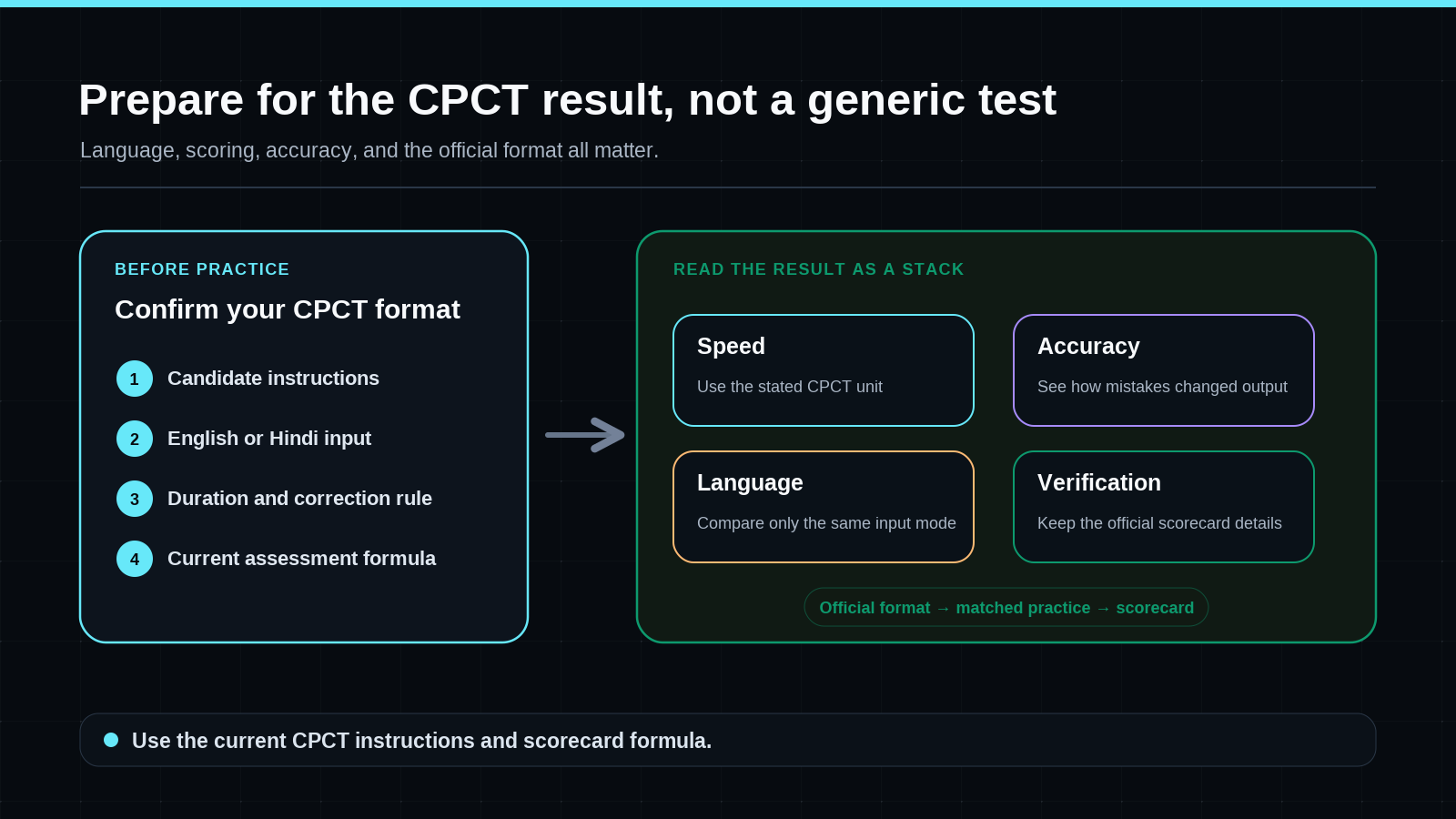
Prepare for CPCT from the current rulebook, candidate instructions, and official assessment formula on cpct.mp.gov.in. Treat English typing, Hindi typing, and computer proficiency as separate parts of the assessment. Match the official keyboard layout and time, practise full passages, and use the published formula when interpreting a mock.
- CPCT is more than a generic WPM test.
- English and Hindi practice need the correct official input setup.
- The official formula, rulebook, and current portal take priority over coaching summaries.
Free Keytopia typing test
Take a typing baseline before your CPCT-specific mock
Use Keytopia for English or native Unicode Hindi InScript drills. Use the official CPCT tools for Remington practice, comparable full mocks, and official scoring.
- PaceAverage, raw, peak and low WPM
- ControlAccuracy, errors, consistency and CPM
- TimingReaction, overlap, hold, rhythm and recovery
- PatternsTimeline, heatmap, word, key and bigram speed
No account needed. Save your history after sign-in.
Begin at the official CPCT portal
Open the CPCT portal and download the current rulebook, candidate instructions, assessment formula, and any current schedule notice.
This guide was last checked on 26 July 2026. Portal rules, score validity, test centers, and schedules can change. Do not use an old screenshot as your final source.
Keytopia is an independent practice product. It does not issue a CPCT scorecard.
CPCT typing test key numbers
These figures come from the official CPCT syllabus, assessment formula, and candidate instructions linked under Sources. Reopen those documents before the examination, because a newer notice takes priority over this table.
| Item | Figure | Where it is published |
|---|---|---|
| Total assessment time | 120 minutes | Official syllabus |
| Computer proficiency section | 75 questions in 75 minutes | Official syllabus |
| English typing section | 15 minutes | Official syllabus |
| Hindi typing section | 15 minutes | Official syllabus |
| Instructions and switchover | 15 minutes | Official syllabus |
| Hindi text standard | Unicode | Official syllabus |
| Hindi keyboard options | Remington or InScript, as named on the portal | Official syllabus |
| Speed reported as | Net words per minute (NWPM) | Official assessment formula |
| Accuracy | Net WPM divided by gross WPM, multiplied by 100 | Official assessment formula |
| Error treatment | Full and half mistakes, as defined in the formula PDF | Official assessment formula |
| Qualifying speed | Set by the employer or recruitment notice, not by this guide | Check the current official notice |
No qualifying words-per-minute figure is printed here on purpose. Recruitment notices set their own requirement for a CPCT scorecard, and that figure changes by post and by year. Use the notice for the job you want.
A practice plan for the CPCT typing test by week
This plan assumes six weeks and three short sessions a week. Shorten it if your exam is closer, but keep the order: setup first, accuracy second, full-length mocks last.
| Week | English typing | Hindi typing | Computer proficiency |
|---|---|---|---|
| 1 | Set up the keyboard and take a 1-minute typing test as a baseline | Confirm the layout named on the portal and learn the character groups you use most | Read the syllabus and sort the topics into known and unknown |
| 2 | Clean five-minute passages at a pace you can hold without errors | Short words and matras in the official layout, no timer | One unknown topic per session |
| 3 | Take the 5-minute typing test once and review weak keys | Full sentences with spaces and punctuation | Timed sets of 25 questions |
| 4 | Move to the 10-minute typing test for stamina | One timed Hindi passage in the official setup | Timed sets of 50 questions |
| 5 | One full 15-minute mock in the official English setup | One full 15-minute mock in the official Hindi setup | One full 75-question mock |
| 6 | Light practice, reread the candidate instructions | Light practice in the official layout only | Review wrong answers, then stop |
Keytopia covers the English column and native Devanagari InScript drills. It does not provide Remington or the CPCT word-based formula, so the Hindi full mocks belong in the authorized CPCT mock environment.
If you are also preparing for an SSC post, the SSC typing test guide explains how the SSC rules differ, and the Hindi typing guide covers layout choice in more depth.
Check access and test-day instructions early
Read the current candidate instructions for identification, reporting time, prohibited items, and test behavior.
If you need an accommodation, contact the official CPCT support channel in advance and follow its process. A practice website cannot decide eligibility or reproduce every test-center condition.
Before the examination, revisit the official portal for any notice or schedule change.
Know the official CPCT assessment structure
The official CPCT syllabus describes a two-hour assessment.
- 75 minutes for 75 multiple-choice questions.
- 15 minutes for English typing.
- 15 minutes for Hindi typing.
- 15 minutes for instructions and switching between the typing sections.
The Hindi test uses Unicode text and the current syllabus names Remington and InScript keyboard options. Confirm the current portal, rulebook, admit-card instructions, and selected layout before the examination. A schedule notice can change dates and reporting details without changing the general syllabus.
Plan English typing, Hindi typing, and the multiple-choice syllabus as separate tracks. A strong result in one section does not prove readiness for the others.
Work through the official typing formula once
The official CPCT formula defines gross words as correct plus incorrect words. Gross words per minute equals gross words divided by minutes. Net words are the correct words. Net words per minute equals net words divided by minutes. Accuracy is net WPM divided by gross WPM, multiplied by 100.
Example for a 15-minute mock:
- Correct words: 189
- Incorrect words: 21
- Gross words: 210
- Gross WPM: 210 ÷ 15 = 14
- Net WPM: 189 ÷ 15 = 12.6
- Accuracy: 12.6 ÷ 14 × 100 = 90 percent
This example explains the published formula. Use the authorized CPCT result as the official score. A character-based WPM result from another platform is not directly equivalent.
Keep Keytopia practice inside its real boundary
Keytopia does not reproduce the official CPCT assessment. It supports native Devanagari content and a Hindi InScript layout, but it does not provide Remington or the CPCT word-based scoring formula.
Use Keytopia for general English practice and focused Unicode Hindi InScript drills. Do not label a Keytopia score as a CPCT mock score. Complete English and Hindi full mocks in the official CPCT mock environment or another setup that matches the current official passage behavior, layouts, duration, and formula.
For Hindi, practise in the exact Unicode layout selected for the examination. Check spaces and word order carefully. The official candidate instructions warn that an extra space can affect evaluation of later words. Reopen those instructions before every final mock.
FAQs
What typing speed is required for CPCT?
Use the current CPCT rulebook and scorecard guidance for any qualifying or job-specific requirement. Employers can also set their own requirement.
Can I practise CPCT on Keytopia?
Use Keytopia for independent English practice and native Unicode Hindi drills with its InScript layout. It does not provide Remington or reproduce the official CPCT word-based formula, so use the authorized CPCT tools for comparable full mocks.
Does Keytopia issue a CPCT certificate?
No. Only the authorized CPCT process can issue an official CPCT scorecard.
What is the CPCT typing test?
The CPCT typing test is the typing part of the Madhya Pradesh Computer Proficiency Certification Test. The published syllabus gives it 15 minutes of English typing and 15 minutes of Hindi typing, scored with the official net-words-per-minute formula, alongside a 75-question computer proficiency section.
Is CPCT typing in Hindi or English?
Both. The syllabus has a separate English typing section and a Hindi typing section, each 15 minutes long. Hindi uses Unicode text with the Remington or InScript keyboard options named on the portal.
How long should I practise for the CPCT typing test?
Most candidates need several weeks of short sessions. Spend the first weeks on the official keyboard setup and accuracy, then add 5-minute and 10-minute timed passages, and finish with full 15-minute mocks in the official environment.
Can I compare a Keytopia WPM score directly with CPCT NWPM?
No. Keytopia and CPCT use different content and scoring. Use Keytopia only for a suitable general drill, then use the official CPCT setup for comparable mocks.
Sources
Independent research, official documentation, and source pages behind the claims above.
- Madhya Pradesh CPCT official portalhttps://www.cpct.mp.gov.in/
- CPCT Rule Book version 1.4https://cpct.mp.gov.in/per/g01/pub/1172/ASM/WebPortal/1/Hindi/PDF/CPCT_Rule_book-V1.4.pdf
- CPCT official typing assessment formulahttps://cpct.mp.gov.in/per/g01/pub/1172/ASM/WebPortal/1/Hindi/PDF/CPCT_Assessment_Formula.PDF
- CPCT official syllabus and assessment structurehttps://www.cpct.mp.gov.in/per/g01/pub/1172/ASM/WebPortal/1/downloads/syllabus.pdf
- CPCT candidate instructionshttps://cpct.mp.gov.in/per/g01/pub/1172/ASM/WebPortal/1/Hindi/PDF/English_inst.pdf
- CPCT official detailed syllabus and assessment structurehttps://www.cpct.mp.gov.in/per/g01/pub/1172/ASM/WebPortal/1/Hindi/PDF/CPCTSyllabus.pdf
- CPCT official candidate instructions for Hindi typinghttps://cpct.mp.gov.in/per/g01/pub/1172/ASM/WebPortal/1/downloads/English_inst.pdf
Key takeaway
Use current CPCT documents, match the official input setup, and judge practice through the official formula.
Free Keytopia typing test
Take a typing baseline before your CPCT-specific mock
Use Keytopia for English or native Unicode Hindi InScript drills. Use the official CPCT tools for Remington practice, comparable full mocks, and official scoring.
No account needed. Save your history after sign-in.
- PaceAverage, raw, peak and low WPM
- ControlAccuracy, errors, consistency and CPM
- TimingReaction, overlap, hold, rhythm and recovery
- PatternsTimeline, heatmap, word, key and bigram speed