
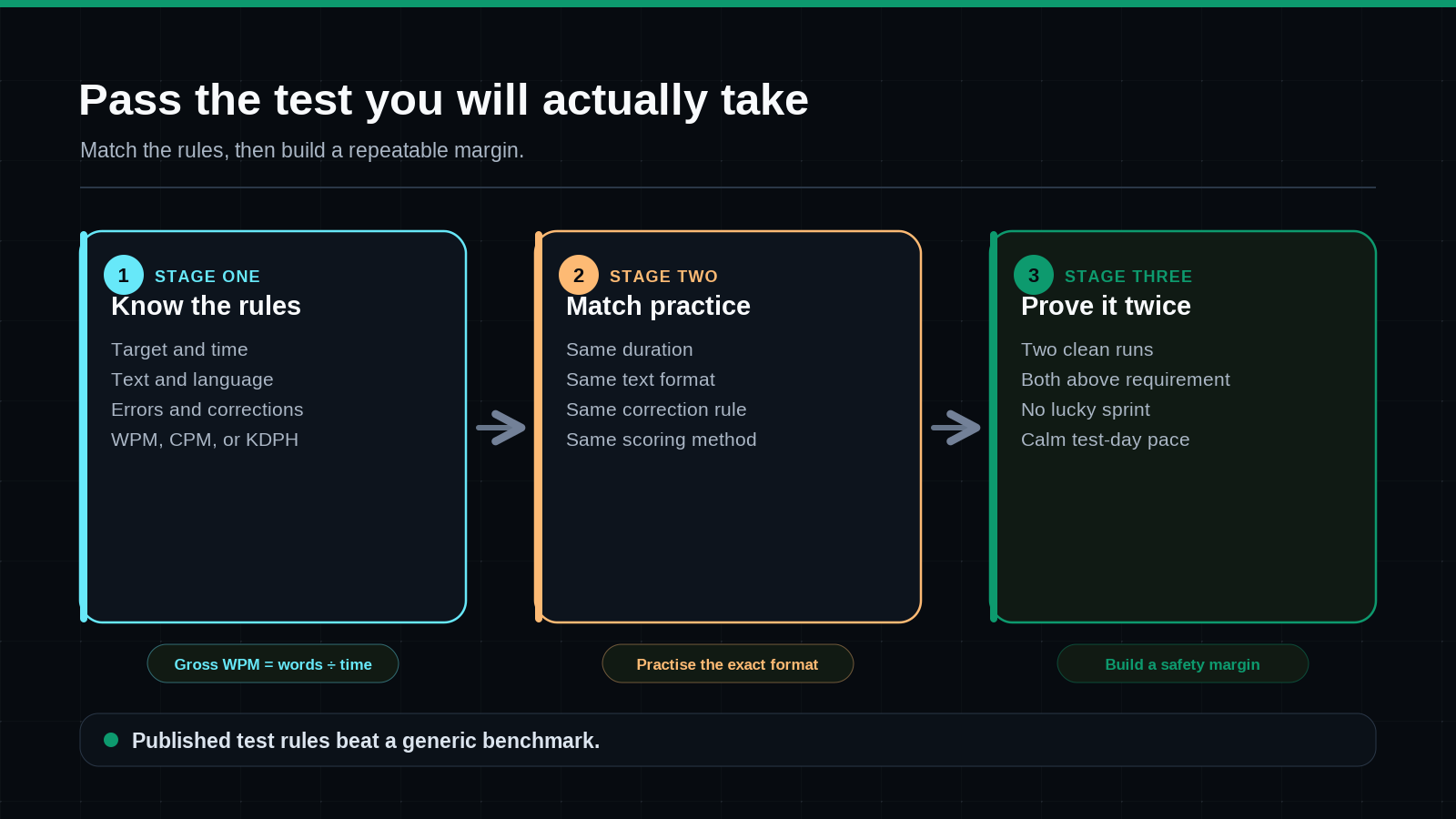
Typing tests do not all use the same rules. First confirm the required score, test length, text type, error penalty, correction policy, and whether the result is WPM, net WPM, CPM, or KDPH. Then practise in matching conditions and aim for a repeatable score above the stated requirement.
- Some tests report gross WPM, while others apply an error penalty or set a separate accuracy requirement.
- When errors are penalized, a controlled pace can score better than a frantic sprint.
- Practicing in the real conditions removes most of the test-day surprise.
Free Keytopia typing test
Take a timed typing test under repeatable conditions
Measure WPM, raw pace, accuracy, errors, consistency, reaction time, and recovery details in one focused run.
- PaceAverage, raw, peak and low WPM
- ControlAccuracy, errors, consistency and CPM
- TimingReaction, overlap, hold, rhythm and recovery
- PatternsTimeline, heatmap, word, key and bigram speed
No account needed. Save your history after sign-in.
What a typing test actually measures
A typing test may report several numbers, and platforms do not calculate all of them in the same way.
Gross WPM usually starts with characters typed divided by five, then divided by the number of minutes. A common net-WPM formula subtracts uncorrected errors per minute from gross WPM. Other tests use a different penalty, count only correct entries, report accuracy separately, or use characters or keystrokes per hour.
That is why a score from one site may not match a score from an employer or exam. Read the published rules before choosing a practice target.
Write down the exact test rules
Before you practise, find out what passing means for this test.
Write down the required score, duration, allowed keyboard, language, text type, correction policy, and whether mistakes reduce the result. Check whether the test uses gross WPM, net WPM, characters per minute, or keystrokes per hour.
Do not rely on a general online benchmark. Employers, schools, certification providers, and government exams can use different standards. The official notice or test provider is the source that matters.
Why slowing down can raise your score
When a test penalizes errors, slowing down a little can make the final score go up.
A frantic pace creates errors, and each error eats into your score. A calm, steady pace makes fewer mistakes, so more of your speed actually counts.
Try two practice runs with the same duration and text type. Type the first near your limit. Type the second at a controlled pace. Compare the scoring fields the real test will use. This is a useful experiment, not a guarantee, because test formulas differ.
Practice the way you will be tested
Surprises hurt your score. Remove them before test day.
Practice on the same kind of keyboard you will use. Practice with the same rules, whether or not you are allowed to fix mistakes. Practice for the same length of time, so a three minute test does not feel like a marathon.
If the test uses plain sentences, practise plain sentences. If it includes numbers and punctuation, practise those too. Keytopia can help you change duration, punctuation, numbers, language, and correction behaviour. It cannot reproduce every employer or exam system, so compare its settings with the official rules.
On test day, stay calm and steady
Warm up first. Type for a minute or two before the real test so your hands are awake.
Sit with your fingers on the home row and your eyes on the text, not the keyboard. Breathe normally. Find a steady rhythm and hold it instead of chasing speed.
If you make a mistake, do not panic and do not freeze. Fix it if the test wants that, then settle straight back into your rhythm. One slip does not decide the score. Losing your composure does.
A simple week-before routine
You do not need to grind for hours. A little, often, beats a lot, once.
Practice ten to fifteen minutes a day for the week before. Spend most of it on accuracy at a calm pace. Add a couple of short speed bursts near the end of each session, then return to calm.
Take a real practice test every day or two so the format stops feeling strange. By the day of the test, it will not feel like a test. It will just feel like another run.
What to do if you are just below the passing score
If you are five WPM short, do not panic and rebuild your whole technique. Look for the leak.
If raw WPM is high but net WPM is low, mistakes are eating your score. Slow down until accuracy climbs, then bring speed back gradually.
If accuracy is high but WPM is low, your hands may be pausing between words. Practice short bursts where you type common word pairs smoothly: in the, of the, to be, and then, for this.
If numbers or punctuation reduce your score, isolate them. Targeted Keytopia drills on commas, periods, capitals, and number-row reaches let you practise the exact text type instead of repeating a general test.
Typing tests feel like one number, but the fix is rarely one thing. Find the weak part and train that part.
FAQs
What is a passing score on a typing test?
There is no universal passing score. Use the number and scoring rules published by the employer, school, exam board, or certification provider.
What is net WPM?
Net WPM is a speed score after an error penalty. One common formula is gross WPM minus uncorrected errors per minute, but platforms can use different formulas. Check the test rules.
Should I fix my mistakes during a typing test?
It depends on the test. Some tests allow Backspace, some count only uncorrected errors, and some restrict corrections. Read the rules first, then practise the same way.
How do I calm my nerves before a typing test?
Warm up for a minute, breathe normally, and hold a steady pace instead of sprinting. Practicing in the same conditions removes most of the surprise.
Sources
Independent research, official documentation, and source pages behind the claims above.
Key takeaway
Start with the official rules. Match the duration, text, language, correction policy, and scoring method as closely as you can. Build a repeatable result above the requirement instead of relying on one lucky run.
Free Keytopia typing test
Take a timed typing test under repeatable conditions
Measure WPM, raw pace, accuracy, errors, consistency, reaction time, and recovery details in one focused run.
No account needed. Save your history after sign-in.
- PaceAverage, raw, peak and low WPM
- ControlAccuracy, errors, consistency and CPM
- TimingReaction, overlap, hold, rhythm and recovery
- PatternsTimeline, heatmap, word, key and bigram speed