A typing score only makes sense with its rules. Check the test duration, text type, correction policy, language, and scoring formula. WPM often treats five characters as one word, but net WPM and error penalties differ by platform and exam. Compare like with like.
- Raw WPM shows attempted pace. Final or net WPM shows what the scoring system accepts.
- Accuracy formulas and error penalties are not identical across every platform.
- CPM and KDPH are useful when a job or exam measures key presses instead of words.
Free Keytopia typing test
Take a timed typing test under repeatable conditions
Measure WPM, raw pace, accuracy, errors, consistency, reaction time, and recovery details in one focused run.
- PaceAverage, raw, peak and low WPM
- ControlAccuracy, errors, consistency and CPM
- TimingReaction, overlap, hold, rhythm and recovery
- PatternsTimeline, heatmap, word, key and bigram speed
No account needed. Save your history after sign-in.
The common WPM convention
Many typing tests treat five characters, including spaces, as one standard word.
If you type 300 accepted characters in one minute, the basic calculation is 300 divided by 5. That gives 60 WPM.
This convention makes passages easier to compare because real words have different lengths. It does not mean that every platform handles errors in the same way.
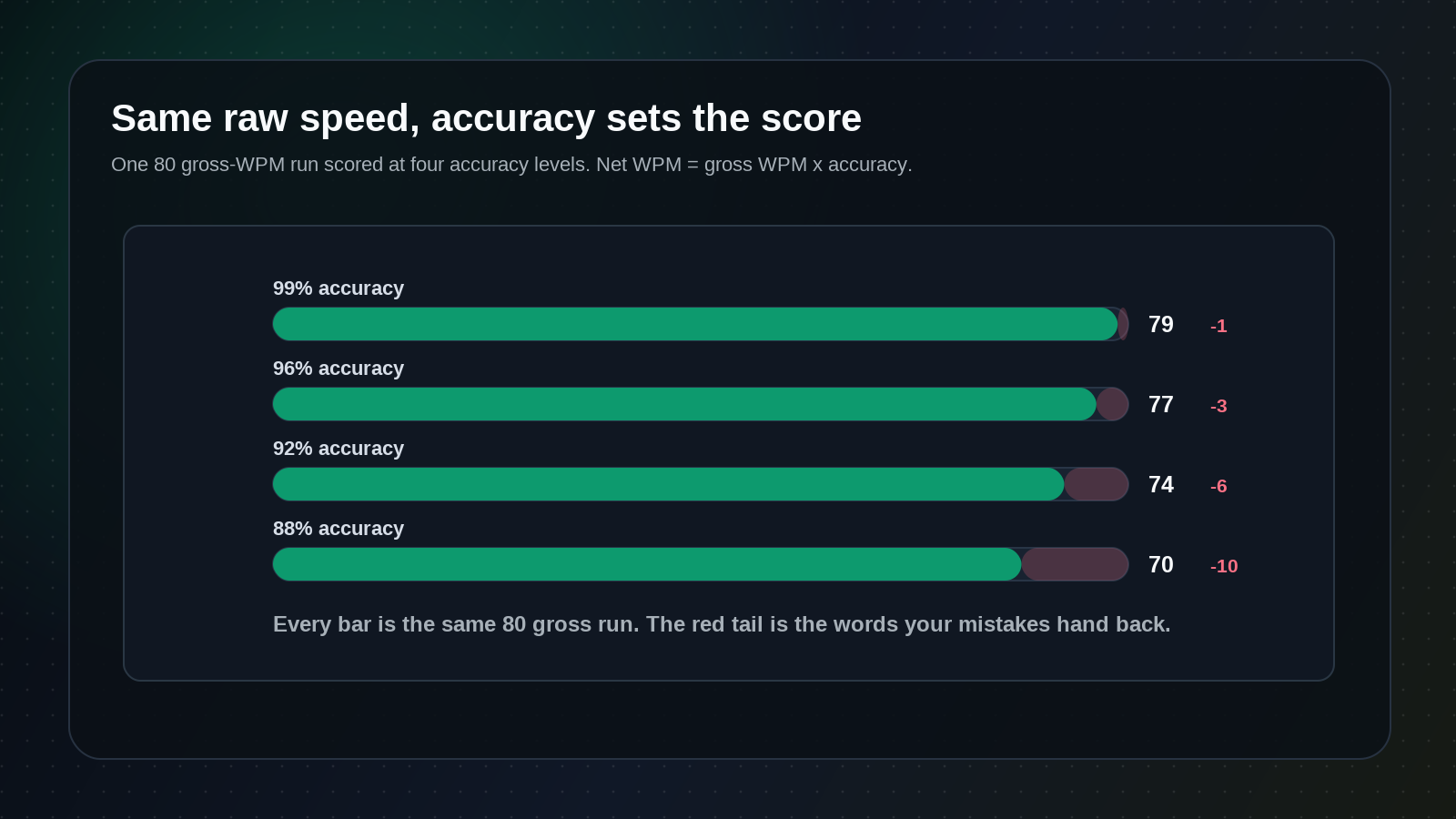
Raw WPM and final WPM answer different questions
Raw WPM shows how quickly the hands moved through the text before the result accounts for mistakes.
Final or net WPM tries to show usable speed. One platform may subtract a fixed penalty. Another may count only correct words. An official exam may use its own definition.
That is why two sites can show different final scores for similar typing. Neither result is meaningful without the formula.
Accuracy is not always calculated the same way
A simple character accuracy formula is correct characters divided by total typed characters.
Some tests work by words instead. The official CPCT assessment, for example, defines accuracy from net words and gross words. It also reports net words per minute as the typing speed.
Read the official assessment document when an exam matters. Do not assume that a practice site's percentage will match the exam result exactly.
Why test length changes the score
A short test rewards quick starts and familiar words. A longer test also measures rhythm, attention, correction habits, and fatigue.
A one-minute score is useful as a repeatable baseline. A three-minute or five-minute score is usually a better picture of sustainable typing. An exam candidate should practise the official duration.
Do not put a fifteen-second personal best next to a ten-minute exam requirement and treat them as equal.
Typing test numbers to remember
Every figure in this table is either arithmetic under the five-character convention or a value published in the official documents linked under Sources.
| Figure | Value | Source |
|---|---|---|
| Characters per standard word | 5, including spaces | Common typing-test convention |
| 300 accepted characters in 1 minute | 60 WPM, or 300 CPM | Arithmetic |
| 35 WPM | About 10,500 key depressions per hour | SSC CHSL 2025 notice |
| 30 WPM | About 9,000 key depressions per hour | SSC CHSL 2025 notice |
| 2,000 key depressions in 15 minutes | 8,000 KDPH | Arithmetic |
| CPCT speed | Net words per minute: correct words divided by minutes | CPCT assessment formula |
| CPCT accuracy | Net WPM divided by gross WPM, multiplied by 100 | CPCT assessment formula |
| Quick baseline | 1 minute | Keytopia guidance |
| Sustained pace | 3 to 5 minutes | Keytopia guidance |
| Exam practice | The official duration | The exam notice |
Keytopia publishes its own rule: final WPM is correctly typed characters divided by five, per minute; raw WPM counts every typed character. Use the 1-minute typing test for a baseline, the 5-minute typing test for working pace, and the 10-minute typing test when an exam runs that long.
Keep WPM, CPM, and KDPH in their own units
WPM, CPM, and KDPH describe different units. A conversion is useful only when the test defines the unit the same way.
A common typing-test convention treats five characters, including spaces, as one standard word. Under that convention, 300 accepted characters in one minute equals 60 WPM. It also equals 300 characters per minute.
KDPH means key depressions per hour. A simple time conversion multiplies accepted key depressions per minute by 60. It does not automatically reproduce an employer or examination formula. Some tests count spaces or corrections differently. Others evaluate whole fields or apply full and half mistakes.
Always record the unit beside the score. Write 60 WPM on a one-minute English transcription test, not simply 60. Write 8,000 KDPH under the named official test rule, not 8,000 WPM. The unit and method are part of the result.
Do not invent net WPM from an unknown formula
A common WPM convention divides characters by five and then divides by minutes. Error treatment is the part that changes.
Suppose a person enters 1,500 characters in five minutes. The basic gross calculation is:
- Divide 1,500 characters by five. The result is 300 standard words.
- Divide 300 by five minutes. The result is 60 gross WPM.
Now suppose the test records errors. One system may subtract an error value from gross WPM. Another may count only accepted characters. An exam may define net words and mistakes in its own document.
Use this rule:
- For personal progress, keep one platform and one test format.
- For a job or exam, use the organizer's published formula.
- For a certificate, include the platform and test conditions.
- For cross-site comparison, compare raw facts only when the definitions match.
Never claim an official net WPM by applying a formula that the official test does not use.
Compare two tests only when their rules match
A score can change even when the typist does not. Test method is part of the measurement.
Before comparing results, check:
- Duration.
- Language and keyboard layout.
- Word list, prose, code, numbers, or another text type.
- Whether punctuation and capitals are included.
- Whether Backspace is allowed.
- How corrected and uncorrected errors are counted.
- Whether the score is gross WPM, accepted-character WPM, net WPM, CPM, or KDPH.
A one-minute common-word test and a five-minute official passage answer different questions. A lower score on harder text is not proof that the skill declined.
Use one stable test for a progress trend. Use the target organizer's official format for job or exam readiness. Keep both results when both questions matter, but label them separately.
FAQs
How is WPM calculated?
A common method divides accepted characters by five, then divides by the number of minutes. Error penalties may change the final score.
Is CPM the same as WPM?
No. CPM counts characters. WPM converts characters into standard five-character words on many tests.
Why is my WPM different on another website?
The text, duration, word list, correction rules, and scoring formula may be different. Compare results only when those settings match.
Why can raw WPM be much higher than final WPM?
Raw WPM reflects attempted pace. The final score applies the platform’s accepted-character or error rule. Check that rule before interpreting the gap or comparing it with another site.
Sources
Independent research, official documentation, and source pages behind the claims above.
- CPCT official typing assessment formulahttps://www.cpct.mp.gov.in/per/g01/pub/1172/ASM/WebPortal/1/Hindi/PDF/CPCT_Assessment_Formula.PDF
- SSC CHSL 2025 official notice with WPM and KDPH equivalencehttps://ssc.gov.in/api/attachment/uploads/masterData/NoticeBoards/Notice_of_adv_chsl_2025.pdf?mode=light
Related Keytopia resources
Product pages and related guides from Keytopia. These are not independent evidence.
Key takeaway
A WPM score is not a universal fact. Keep the rules with the result and compare only tests that use the same conditions.
Free Keytopia typing test
Take a timed typing test under repeatable conditions
Measure WPM, raw pace, accuracy, errors, consistency, reaction time, and recovery details in one focused run.
No account needed. Save your history after sign-in.
- PaceAverage, raw, peak and low WPM
- ControlAccuracy, errors, consistency and CPM
- TimingReaction, overlap, hold, rhythm and recovery
- PatternsTimeline, heatmap, word, key and bigram speed