Typing test anxiety becomes easier to manage when the test feels familiar. Practise the official duration and rules, rehearse the setup, start below your maximum pace, and use a simple recovery cue after mistakes. If anxiety causes significant distress outside the test, seek support from a qualified professional.
- Familiarity removes avoidable uncertainty.
- A safe opening pace protects accuracy and rhythm.
- One mistake should not control the next ten words.
Free Keytopia typing test
Take a timed typing test under repeatable conditions
Measure WPM, raw pace, accuracy, errors, consistency, reaction time, and recovery details in one focused run.
- PaceAverage, raw, peak and low WPM
- ControlAccuracy, errors, consistency and CPM
- TimingReaction, overlap, hold, rhythm and recovery
- PatternsTimeline, heatmap, word, key and bigram speed
No account needed. Save your history after sign-in.
First remove the unknowns
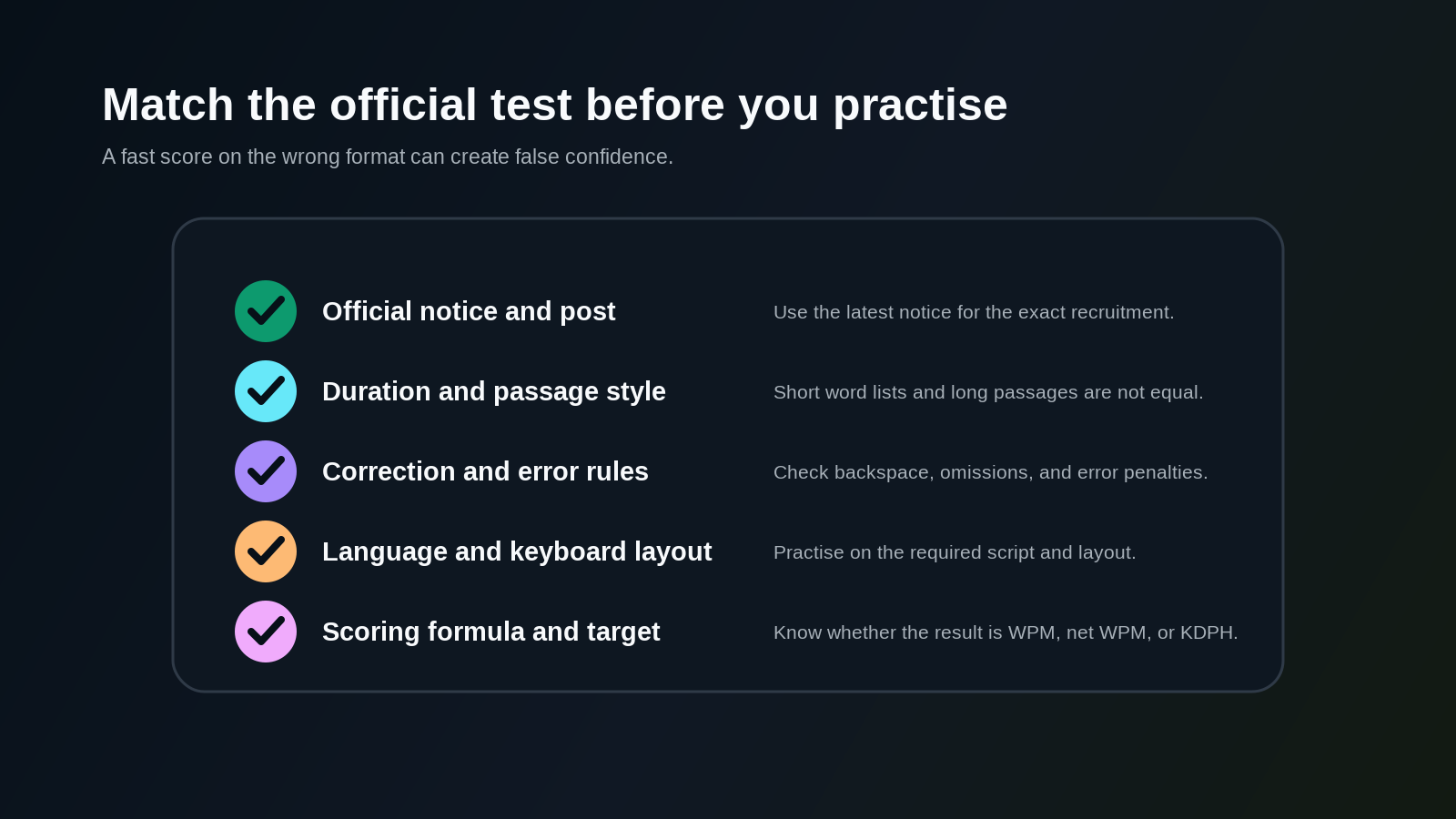
Read the official instructions before building a practice plan.
Find the duration, scoring method, allowed corrections, keyboard layout, language, and identification rules. Check whether the test includes punctuation, numbers, or formatting.
Do not rely only on a video or coaching post. Rules can change. Use the notice or candidate guide from the organization running the test.
Build familiarity in stages
Start with untimed practice on the same kind of text. Add a visible timer when the movements feel stable.
Next, use the official duration without trying to reach a target. Then add the target pace. Finish with a few full mocks on different days.
This order helps you practise the test without making every session feel like a final attempt.
Choose a safe opening pace
The first line often feels urgent because the clock has started. Rushing it can create errors and more tension.
Begin slightly below your maximum practice pace. Let your eyes settle into the passage. Raise the rhythm only after the first few clean lines.
Your goal is not the fastest first ten seconds. It is the strongest complete score under the real scoring rules.
Use one recovery cue
Choose a short cue such as breathe, next word, or light hands.
After a mistake, follow the correction rule and return to the next word. Do not replay the error in your head. That spends attention without fixing the score.
Practise the cue during mock tests. It must be familiar before test day.
Rehearse the practical details
Before an online test, check the browser, connection, power, keyboard, input language, and notifications.
Before an in-person test, confirm the location, reporting time, documents, and current candidate instructions. You may not control the keyboard, so practise once on an ordinary keyboard if you normally use a special one.
Stop heavy practice before the test. A light warm-up is more useful than a tiring last-minute sprint.
Know when to ask for help
Nervousness before a test is common. This guide offers practice ideas, not mental health treatment.
If anxiety is severe, persistent, or affects daily life, contact a qualified health professional. If you need an accommodation, ask the test organizer about its process early. Do not assume that a practice website can approve or predict an accommodation.
Use a seven-day familiarity ladder
The goal of the week is to make the format familiar, not to prove a new personal best every day.
Day 1: Read the official instructions. Write down duration, scoring, corrections, language, keyboard, and identification rules.
Day 2: Type similar text without a timer. Learn the passage style and correction behavior.
Day 3: Use half the official duration at a comfortable pace.
Day 4: Complete the full duration without a target score.
Day 5: Complete one full mock with the target visible.
Day 6: Rehearse the setup, first line, and recovery after one deliberate mistake.
Day 7: Take one normal mock, review it once, and stop.
If a day feels too difficult, repeat the earlier step. More frantic attempts are not the same as more useful exposure.
Prepare a test-day preflight checklist
For an online test:
- Confirm the link, start time, browser, internet connection, power, and permitted keyboard.
- Set the required language and layout.
- Close unrelated notifications and applications when the rules allow it.
- Check whether Backspace, refresh, copy, paste, or restarting is restricted.
For an in-person test:
- Confirm the venue, reporting time, identification, and prohibited items.
- Read the accommodation process before test day.
- Practise once on an ordinary keyboard if the center does not promise your usual model.
Use the organizer's current instructions. A coaching video or old screenshot cannot override them.
Use one recovery sequence after a mistake
Choose a simple sequence and rehearse it during mocks:
- Follow the official correction rule.
- Release unnecessary pressure from the hands.
- Move the eyes to the next word or line.
- Resume at the planned pace.
Do not speed up to repay the lost second. That often creates a second error. One mistake has a limited cost. Carrying it through the next paragraph costs more.
This article describes test preparation, not mental health treatment. Occasional test nerves are common. If anxiety is persistent, severe, or interferes with daily life, contact a qualified health professional. Ask the test organizer early when an accommodation may be needed.
FAQs
Should I watch the timer during a typing test?
Usually not. Check the official interface in advance, then keep attention on the passage unless the test requires time-based decisions.
How many mock typing tests should I take?
Use enough to make the format familiar without exhausting yourself. A few full mocks across several days are more useful than many frantic attempts in one sitting.
What should I do after a mistake?
Follow the official correction rule, use your recovery cue, and continue. Do not let one error change the pace of the whole test.
Should I keep taking mocks until I get a reassuring score?
No. Set the number of mocks before the session. Review one result, choose one next step, and stop before fatigue turns practice into repeated panic.
Sources
Independent research, official documentation, and source pages behind the claims above.
- Staff Selection Commission, official website and candidate noticeshttps://ssc.gov.in/
- Madhya Pradesh CPCT, candidate instructionshttps://cpct.mp.gov.in/per/g01/pub/1172/ASM/WebPortal/1/Hindi/PDF/English_inst.pdf
- National Institute of Mental Health, anxiety disordershttps://www.nimh.nih.gov/health/topics/anxiety-disorders
- NIMH, deciding when mental health concerns need more helphttps://www.nimh.nih.gov/health/publications/my-mental-health-do-i-need-help
Key takeaway
Make the test familiar, protect the opening pace, and practise a calm return after errors.
Free Keytopia typing test
Take a timed typing test under repeatable conditions
Measure WPM, raw pace, accuracy, errors, consistency, reaction time, and recovery details in one focused run.
No account needed. Save your history after sign-in.
- PaceAverage, raw, peak and low WPM
- ControlAccuracy, errors, consistency and CPM
- TimingReaction, overlap, hold, rhythm and recovery
- PatternsTimeline, heatmap, word, key and bigram speed