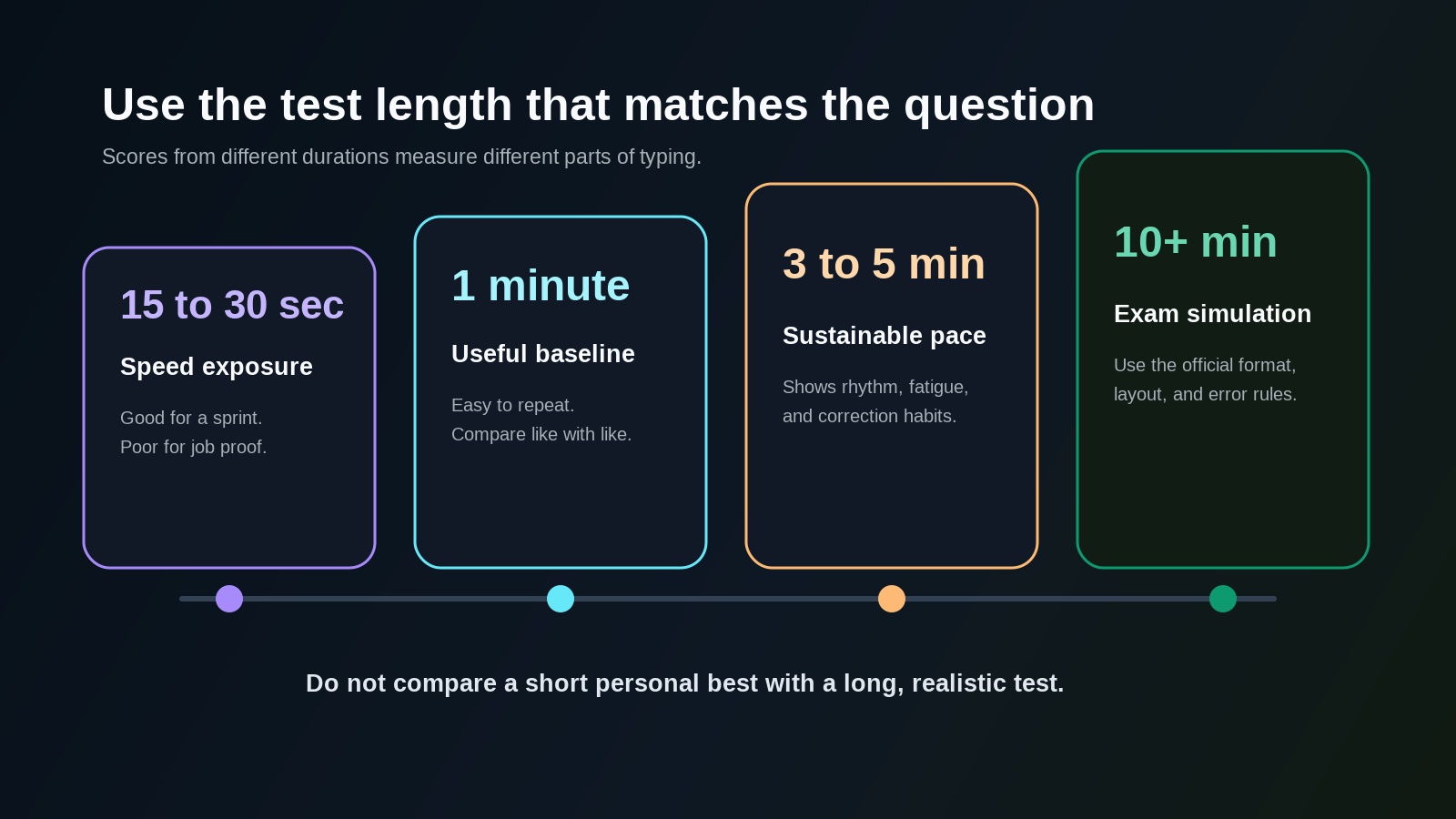
Use a one-minute typing test for a quick, repeatable baseline. Use three to five minutes to check rhythm and normal working pace. Use the exact official duration when preparing for an exam or hiring test. Very short tests are useful for warm-ups, but they can exaggerate speed.
- Test duration changes what the score measures.
- Short tests reward bursts. Longer tests reveal rhythm, tension, and recovery.
- A fair comparison needs the same duration, text type, and scoring rules.
Free Keytopia typing test
Take a timed typing test under repeatable conditions
Measure WPM, raw pace, accuracy, errors, consistency, reaction time, and recovery details in one focused run.
- PaceAverage, raw, peak and low WPM
- ControlAccuracy, errors, consistency and CPM
- TimingReaction, overlap, hold, rhythm and recovery
- PatternsTimeline, heatmap, word, key and bigram speed
No account needed. Save your history after sign-in.
The best length depends on the question
A typing test is a sample. A short sample answers a different question from a long one.
If you want a quick weekly check, one minute is usually enough. If you want to know how well you hold pace during real work, use three to five minutes. If an exam lasts ten minutes, practise ten-minute passages.
There is no single duration that proves every kind of typing ability.
Use very short tests for warm-ups
Tests under thirty seconds are good for waking up the hands and trying a faster rhythm.
They are poor evidence of sustained pace. A familiar opening, one easy sentence, or a lucky burst can change the result sharply. Use the score as a practice signal, not as a job claim or long-term benchmark.
Use one minute for a repeatable baseline
A one-minute test is quick enough to repeat without taking over the session. It includes more words than a short sprint and gives errors time to affect the score.
Take one or two normal attempts. Do not restart until you find an easy passage. Record accuracy with WPM. Repeat the same settings on the same device when you want to measure change.
Use three to five minutes for working pace
Longer tests show whether the first-minute pace survives.
Watch for rising shoulders, heavier key presses, more backspace use, or a drop in accuracy. These signs can point to tension, weak endurance, or a pace that is too aggressive.
This duration is useful for writers, students, support staff, and other people who type continuous text.
Copy the official format for an exam
Exam practice should match the current official notice.
Check the duration, language, passage style, correction rules, and scoring method. Some tests use net words per minute. Others use keystrokes, error deductions, or a custom formula.
A one-minute score can guide practice, but it does not replace a full mock under the official rules.
Compare like with like
Keep these settings the same:
- Test duration
- Language and keyboard layout
- Word list or passage style
- Punctuation and numbers
- Error handling
- Device and keyboard when possible
Keytopia lets you run a quick guest test. Save the setup you used, then repeat it when you want a fair progress check.
Use a two-test protocol when the result matters
One test length cannot show both burst speed and sustained control. Use two lengths when you need a dependable picture.
Start with a one-minute test. It gives you a repeatable baseline. Rest for two or three minutes. Then take a three-minute or five-minute test with the same language, text style, punctuation setting, and keyboard.
Consider this example:
- One-minute result: 72 WPM, 97 percent accuracy, 84 percent consistency
- Five-minute result: 61 WPM, 94 percent accuracy, 68 percent consistency
The first result shows useful short-run pace. The longer result shows that the pace falls when the task continues. The lower accuracy and consistency support the same diagnosis. The next plan should include endurance and steady rhythm. Repeating more one-minute sprints would miss the main problem.
Now consider a second result:
- One-minute result: 63 WPM, 98 percent accuracy
- Five-minute result: 61 WPM, 98 percent accuracy
This typist has a stable working pace. Short speed blocks may now be more useful than more endurance work.
These examples are not universal pass rules. They show how two lengths answer different questions.
Measure the drop without inventing a pass mark
You can describe the difference between a short and long test without calling it good or bad.
Use this simple calculation:
- Subtract the long-test WPM from the short-test WPM.
- Divide the difference by the short-test WPM.
- Multiply by 100.
For 72 WPM on one minute and 61 WPM on five minutes, the difference is 11 WPM. Eleven divided by 72 is about 0.153. The longer score is about 15 percent lower.
The percentage is a trend marker. It is not a medical measure or an official standard. Read it with the performance timeline, accuracy, errors, and consistency.
Use this decision guide:
- Small WPM drop with stable accuracy: the short result is close to sustainable pace.
- Large WPM drop with falling accuracy: reduce the opening pace and train longer passages.
- Large WPM drop with stable accuracy: check attention, text difficulty, and pauses on uncommon words.
- Similar WPM with rising errors: the final score may hide growing correction cost.
Repeat the same pair of tests after several practice sessions. One day of poor sleep or an unusually difficult passage can change the result.
Use retest rules that reduce noise
A fair retest controls the choices that can move the score.
Keep these rules:
- Use the same duration and practice mode.
- Use the same language and keyboard layout.
- Keep punctuation and numbers in the same state.
- Use the same correction rule.
- Use the same device when possible.
- Warm up for the same amount of time.
- Take one normal result instead of restarting for an easy passage.
If the decision is important, use the middle result from three comparable tests on different days. The middle result is less sensitive to one lucky or difficult run.
For an exam or hiring test, the official duration remains the main format. Use the one-minute test only as a quick practice check. Copy the official passage type, correction policy, language, and scoring method during full mocks.
FAQs
Is a 15-second typing test accurate?
It can show burst speed, but it is too short to show normal endurance. Treat it as a warm-up or speed drill.
Is one minute enough for a typing test?
It is enough for a useful quick baseline when you also record accuracy and keep the settings consistent.
Why is my WPM lower on a longer test?
Longer tests reveal fatigue, tension, hard passages, and recovery after mistakes. The lower score may be a better estimate of sustained pace.
Should I compare my one-minute WPM with my five-minute WPM?
Compare them to learn how well your pace lasts, but do not treat them as the same test. Record both durations and keep the other settings steady.
Sources
Independent research, official documentation, and source pages behind the claims above.
- U.S. Office of Personnel Management, clerical and typing requirementshttps://www.opm.gov/policy-data-oversight/classification-qualifications/general-schedule-qualification-standards/
- Staff Selection Commission, official website and noticeshttps://ssc.gov.in/
- Madhya Pradesh CPCT, official websitehttps://www.cpct.mp.gov.in/
- CPCT official candidate instructionshttps://cpct.mp.gov.in/per/g01/pub/1172/ASM/WebPortal/1/Hindi/PDF/English_inst.pdf
Key takeaway
Use one minute for a quick baseline, several minutes for sustained pace, and the official duration for exam practice.
Free Keytopia typing test
Take a timed typing test under repeatable conditions
Measure WPM, raw pace, accuracy, errors, consistency, reaction time, and recovery details in one focused run.
No account needed. Save your history after sign-in.
- PaceAverage, raw, peak and low WPM
- ControlAccuracy, errors, consistency and CPM
- TimingReaction, overlap, hold, rhythm and recovery
- PatternsTimeline, heatmap, word, key and bigram speed