
Bigram and trigram practice works best when it starts with a pattern that actually slows you down. Practise the pattern in short words, then sentences, then normal text. Keep the movement relaxed and verify that the gain appears in a full typing test.
- A bigram is a two-letter sequence. A trigram is a three-letter sequence.
- Choose patterns from your own errors and pauses.
- Move from isolated practice to normal sentences so the skill transfers.
Free Keytopia typing test
Take a typing test and inspect real keyboard control
Go beyond one WPM number with performance timeline, word speed, per-key speed, weak keys, and bigram analysis.
- PaceAverage, raw, peak and low WPM
- ControlAccuracy, errors, consistency and CPM
- TimingReaction, overlap, hold, rhythm and recovery
- PatternsTimeline, heatmap, word, key and bigram speed
No account needed. Save your history after sign-in.
What bigrams and trigrams are
A bigram is a pair of letters that appears in order, such as th, he, or ing minus its final letter. A trigram is a three-letter sequence, such as the, ing, or ion.
Typing is full of these small movements. A common pattern can appear across hundreds of words. Making one movement smoother may help more than repeating a rare difficult word.
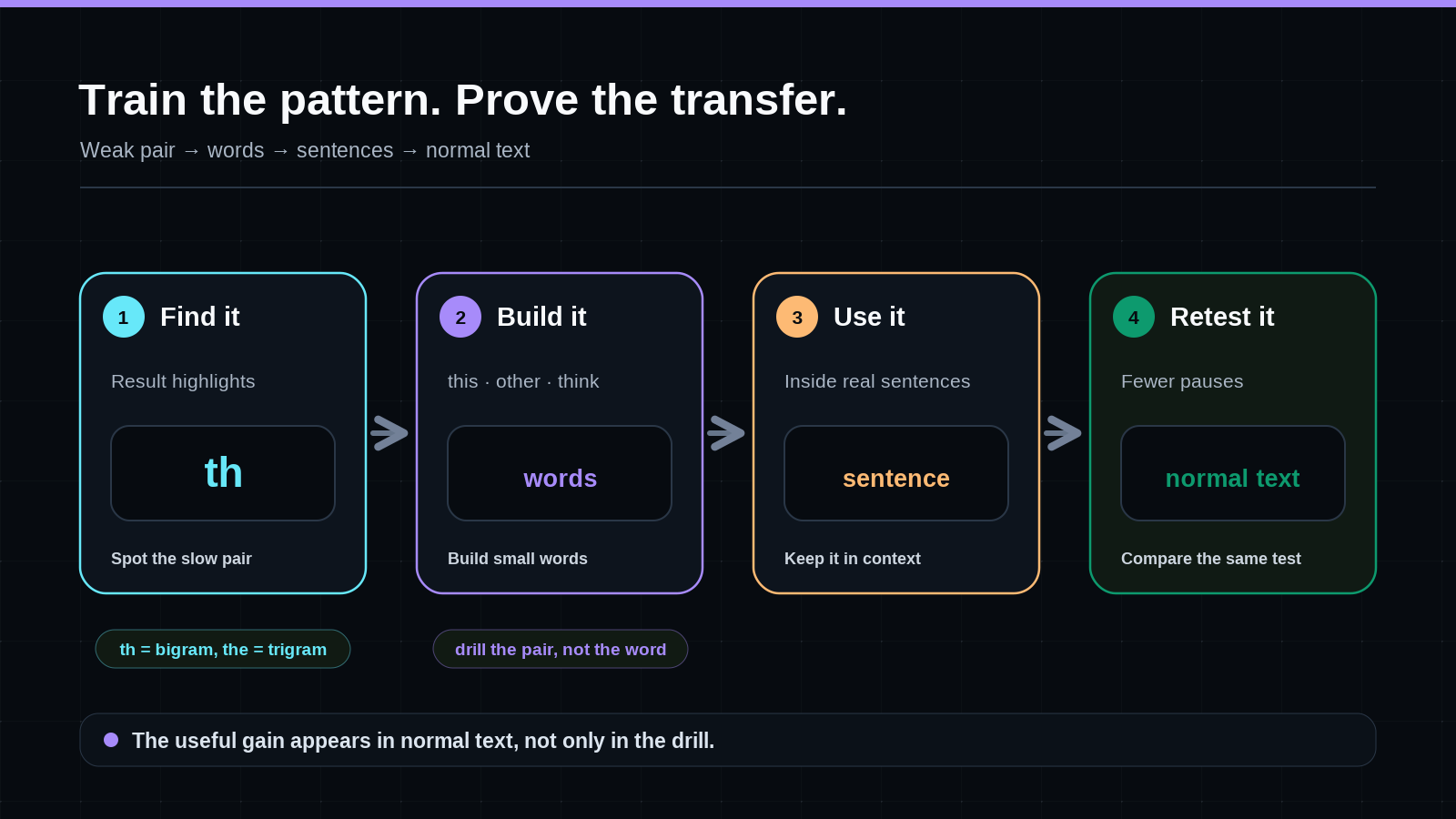
Find a pattern that matters
Do not begin with a generic list of every English bigram.
Review a typing result and look for repeated errors, pauses, or corrections. The useful pattern may involve a letter pair, a capital, punctuation, or a hand change.
Choose one or two patterns for the session. If there is no evidence that a pattern is weak, it does not need special practice.
Use a three-step drill
Start with short, real words. For th, you could use the, this, that, with, other, and think.
Next, type short sentences that place the pattern in different positions. Keep the words meaningful so the eyes and hands work together.
Finish with normal text. Check whether the pattern now passes without a pause. Isolated speed is not enough if it disappears in a paragraph.
Keep the movement small and calm
Slow the drill down when a finger reaches too far, another finger takes over, or the hand becomes tight.
Repeat a clean movement a few times. Then change the surrounding word. Endless repetition can make the drill automatic without making it flexible.
Stop when the movement becomes sloppy. A short clear signal is better than a long tired one.
Practise language-specific patterns
Common patterns change with language. So do accented letters, punctuation, and keyboard layouts.
Use text from the language and layout you need in real life. Do not assume that an English bigram list will solve a Hindi, French, German, or programming problem.
For code, the useful sequence may include brackets, quotes, operators, or indentation rather than a word fragment.
Measure transfer, not drill records
Retest with the same normal passage format after several sessions.
Look for fewer pauses, fewer errors on the target pattern, and steadier pace. A higher score inside the drill only proves that you learned the drill.
Keytopia result details can help you choose a weak pattern, practise it, and return to a broader test.
Turn one slow pair into a useful drill
A bigram is a two-character sequence such as th, he, in, or a comma followed by a space. A trigram is a three-character sequence such as the, ing, or ion.
Start with a result that shows a repeated slow or inaccurate pattern. Suppose th is slow. Build the drill in three layers:
- Short words: the, this, that, with, think.
- Short phrases: the path, with this, think that through.
- Normal sentences: The path through the park was worth the walk.
Use several clean repetitions at a controlled pace. Change the surrounding word before the movement becomes mindless. The goal is to make the pair flexible inside real language, not to set a record on two letters.
Separate a movement problem from a reading problem
The same slow pair can have different causes.
- The wrong finger moves: slow down and restore the intended finger path.
- The hand shifts before the pair: reset from a known position and reduce the reach.
- The pair is accurate in isolation but slow in words: use phrases and sentences.
- The pair fails only in unfamiliar words: read one word ahead and lower the pace.
- The pair fails only with capitals or punctuation: include that exact surrounding pattern.
Do not assume every slow bigram needs a finger drill. A pause can come from reading, language familiarity, punctuation, or the next word. Compare the pair in several words before choosing the cause.
Use a transfer test with a clear pass rule
Retest on normal text after two or three short drill sessions. Keep the duration and text type comparable with the original result.
The drill transferred when the target pair causes fewer errors or shorter pauses without making the rest of the passage worse. A higher drill score alone is not enough.
Use this decision:
- Cleaner pair and stable overall accuracy: return it to normal practice.
- Faster pair but more errors: lower the drill pace.
- Clean drill but no change in text: add more varied words and sentences.
- No repeated weakness in the new result: choose a different bottleneck.
Train one or two patterns at a time. A long list makes it difficult to know which movement changed.
FAQs
How many bigrams should I practise at once?
One or two weak patterns are enough for a focused session. A large list makes it harder to learn what changed.
Should I type a bigram hundreds of times?
Usually no. Use several clean repetitions, change the word or sentence, and stop when form becomes careless.
Do bigram drills improve WPM?
They can help when a common pattern is a real bottleneck. The only useful proof is better performance in normal text.
Can punctuation be treated as a bigram or trigram?
Yes. A comma-space pair, a capital-letter sequence, or a code symbol pattern can be trained when that exact sequence causes a repeated pause or error.
Sources
Independent research, official documentation, and source pages behind the claims above.
Key takeaway
Pick a pattern from real evidence, train it in context, and confirm the improvement in normal text.
Free Keytopia typing test
Take a typing test and inspect real keyboard control
Go beyond one WPM number with performance timeline, word speed, per-key speed, weak keys, and bigram analysis.
No account needed. Save your history after sign-in.
- PaceAverage, raw, peak and low WPM
- ControlAccuracy, errors, consistency and CPM
- TimingReaction, overlap, hold, rhythm and recovery
- PatternsTimeline, heatmap, word, key and bigram speed