To move from 30 or 40 WPM toward 60 WPM, keep the keyboard map stable, remove repeated pauses, and protect accuracy. Practise common word patterns, weak keys, punctuation, and two to five minutes of continuous text. Use short speed blocks, then return to a clean pace.
- The goal is a repeatable 60 WPM, not one lucky short test.
- Pauses between common words often matter as much as individual key speed.
- Longer tests show whether the new pace is stable.
Free Keytopia typing test
Take a typing test before choosing your next drill
See average, raw, peak, and low WPM alongside accuracy, consistency, word speed, rhythm, and your performance timeline.
- PaceAverage, raw, peak and low WPM
- ControlAccuracy, errors, consistency and CPM
- TimingReaction, overlap, hold, rhythm and recovery
- PatternsTimeline, heatmap, word, key and bigram speed
No account needed. Save your history after sign-in.
How to increase typing speed from 40 to 60 WPM
To increase typing speed from 40 to 60 WPM, stop forcing faster finger movement and remove what is slowing the hands down: pauses between common words, repeated errors on a few keys, and a pace that collapses after the first minute. A clean 40 WPM typist usually has the keyboard map already. The missing 20 WPM is mostly rhythm and accuracy, which is why the plan below spends more time on control than on sprinting.
Expect the number to move in a band rather than in a straight line. A good sign is the middle of your last five comparable results climbing while accuracy stays flat or improves.
| Week | Focus | Session shape | Example target from a 40 WPM baseline |
|---|---|---|---|
| 1 | Protect accuracy | Short passages, calm corrections, same baseline test | Accuracy stable at or above 96% at 40 WPM |
| 2 | Remove pauses | Two weak keys or letter pairs inside real words, one normal paragraph to finish | 42 to 46 WPM with no new error patterns |
| 3 | Speed exposure | Three 20-second blocks slightly above normal pace, a calm minute between | 46 to 52 WPM on one-minute tests |
| 4 | Transfer | Three-minute text with capitals and punctuation, one passage like your real work | 48 to 55 WPM on a three-minute test |
The targets are an example for someone starting near a clean 40 WPM. Start lower and the same shape still applies; start with many errors and week 1 may take two weeks. Reaching a repeatable 60 WPM often takes longer than four weeks, and that is normal.
Measure with the same settings every time: the 1-minute typing test for quick checks and the 3-minute typing test for the weekly result.
Make sure the baseline is real
Use a one-minute test and a three-minute test with the same text settings. If the scores are very different, endurance or consistency is part of the problem.
Look at accuracy and weak keys. A 40 WPM result with many corrections needs a different plan from a clean 40 WPM result.
Write down the normal range from several tests. Do not build the plan around the highest number.
Remove pauses before forcing faster movement
At this stage, many learners know every letter. The delay happens between letters or words.
Practise common pairs and short phrases. Read one or two words ahead. Keep the hands moving lightly through familiar text.
Do not attack difficult words. Let them take a little longer, then return to the normal rhythm.
Use a simple four-part session
Try this twelve-minute session:
- Two minutes of easy warm-up.
- Four minutes on weak keys or word pairs.
- Three short speed blocks with calm typing between them.
- One three-minute normal test.
Stop the speed block when form breaks. The final normal test shows whether the faster feeling can return to clean typing.
Add real text before the target feels easy
A simple word list can make 60 WPM arrive early. Add capitals, punctuation, and longer sentences.
If you need typing for work, practise the kind of text you use. If you need an exam, copy the official format. If you are learning for general fluency, use quotes and longer passages.
The target is useful only when it survives the text you care about.
Track a range, not one number
A stable result is a band. You may type a little faster when rested and a little slower on difficult text.
Track the last five comparable tests. Look for a rising middle, steady accuracy, and fewer pauses. Keep the target above the requirement if a job or exam is involved, because test-day conditions can feel different.
Progress may appear first as better control. The WPM increase can follow later. If the band stops moving for two or three weeks, read why your typing speed is not improving before changing the plan, and once 60 WPM is repeatable, the 100 WPM guide covers the next stage. A short daily session in one of the typing games can keep practice going on days when a test feels like a chore, as long as accuracy stays in view.
Choose the plan from the shape of the baseline
Take three comparable one-minute tests and one three-minute test. Use the same language, text type, punctuation setting, and keyboard.
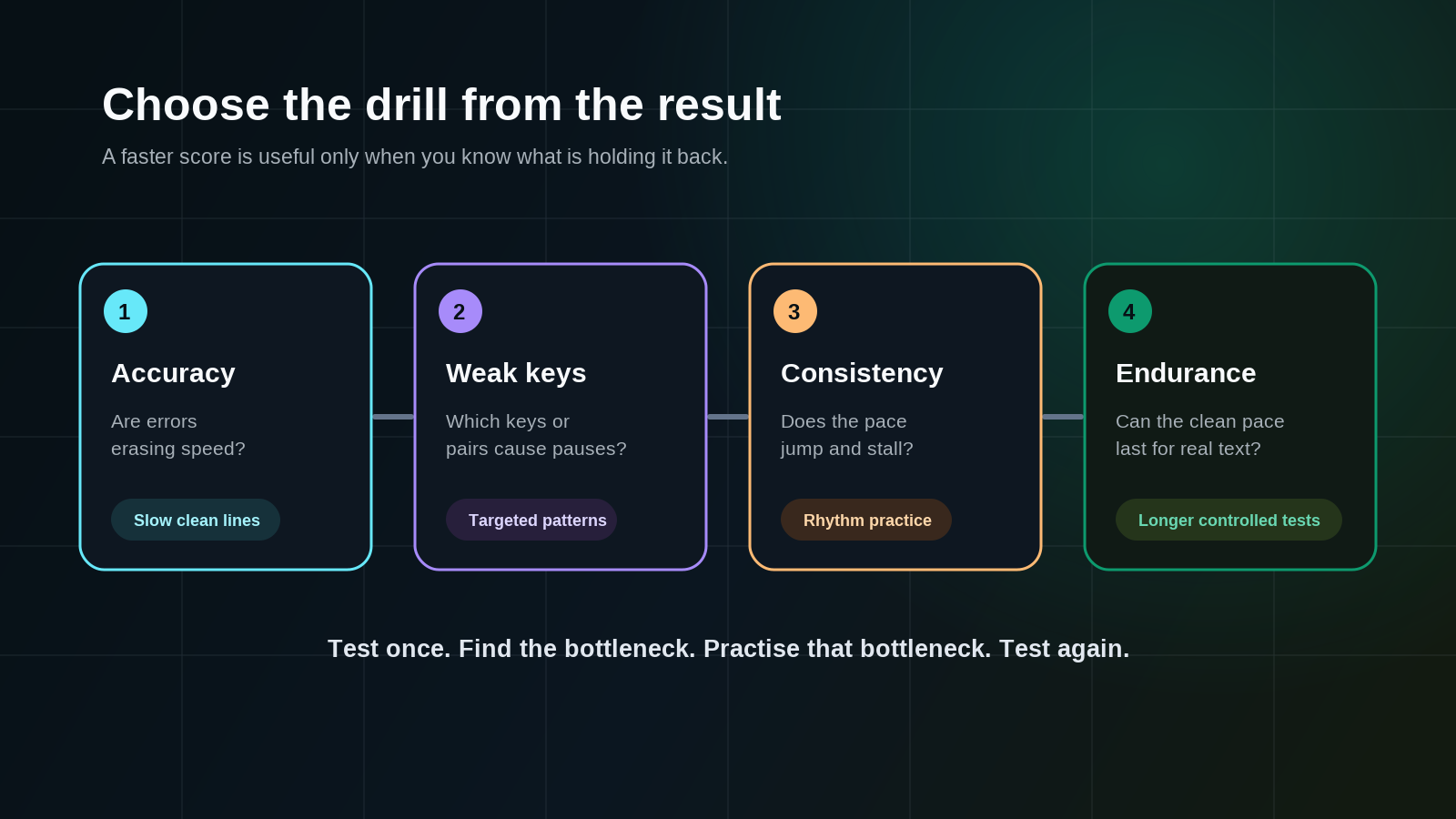
Choose the next drill from the pattern:
- Raw pace is much higher than usable WPM: errors and corrections are cancelling speed. Train accuracy first.
- One or two keys or pairs cause most pauses: use a targeted weak-pattern drill.
- One-minute scores are stable but the three-minute score falls sharply: train endurance at a calmer pace.
- Accuracy is stable but every result sits in a narrow range: add short controlled speed exposure.
- Results swing widely under the same settings: train rhythm and collect more normal runs before changing the target.
Do not combine all five fixes. Work on the clearest limit for one week and retest.
Use a four-week path from control to transfer
Week 1: Protect accuracy. Use short passages, correct repeated errors calmly, and keep the same baseline test.
Week 2: Remove pauses. Practise two weak keys or common letter pairs inside real words. Finish each session with one normal paragraph.
Week 3: Add speed exposure. Use three blocks of twenty seconds slightly above the normal pace. Put one calm minute between the blocks. Stop when the faster movement creates repeated errors.
Week 4: Build transfer. Use three-minute text with capitals and punctuation. Add one passage that resembles work, study, or the target exam.
Retest at the end of each week, not after every drill. Daily test chasing can hide whether the practice itself is improving.
Judge progress from a range, not one 60 WPM screenshot
Suppose the first five comparable results are 38, 41, 39, 44, and 40 WPM. The useful baseline is about 40 WPM, not the single 44.
After four weeks, the next five are 47, 49, 46, 51, and 48 WPM with similar or better accuracy. The target has not reached 60, but the normal range has moved. That is real progress.
Keep three records:
- The middle of the last five comparable scores.
- Accuracy and repeated error patterns.
- The three-minute result on realistic text.
Reach 60 WPM as a repeatable range before treating it as a job or exam capability. A short personal best is a milestone, not proof that the pace will survive a different passage.
FAQs
How long does it take to reach 60 WPM?
It depends on your current technique, accuracy, and practice frequency. Use weekly trends instead of a promised number of days.
Is 60 WPM good?
It is a useful pace for many school and office tasks when accuracy and comfort are strong. Some jobs and exams use different requirements.
Should I use only one-minute tests?
No. Use them for quick checks, then add three-minute or longer tests to make sure the pace survives real text.
How long does it take to go from 40 to 60 WPM?
There is no fixed answer. With a clean 40 WPM baseline and four or five short sessions a week, many learners see the middle of their results move into the high 40s or low 50s within about a month, and a repeatable 60 WPM often takes longer. Starting accuracy, practice frequency, and the text you practise on change the timeline.
What should improve before my WPM reaches 60?
Look for fewer repeated errors, fewer pauses, a narrower result range, and a smaller gap between short and longer tests. Those gains often arrive before the headline target.
Sources
Independent research, official documentation, and source pages behind the claims above.
Related Keytopia resources
Product pages and related guides from Keytopia. These are not independent evidence.
Key takeaway
The path from 30 or 40 WPM to 60 WPM is usually smoother rhythm, fewer pauses, and stable accuracy. Build a repeatable range.
Free Keytopia typing test
Take a typing test before choosing your next drill
See average, raw, peak, and low WPM alongside accuracy, consistency, word speed, rhythm, and your performance timeline.
No account needed. Save your history after sign-in.
- PaceAverage, raw, peak and low WPM
- ControlAccuracy, errors, consistency and CPM
- TimingReaction, overlap, hold, rhythm and recovery
- PatternsTimeline, heatmap, word, key and bigram speed