
A flat score can come from repeated errors, test familiarity, text difficulty, rhythm, fatigue, tension, or practice that no longer challenges the target skill. Keep the test conditions stable, inspect the pattern, and change one variable at a time.
- Plateaus happen at many speeds, not only beginner speeds.
- Most stuck typists need targeted practice, not another normal speed test.
- Accuracy, weak words, rhythm, reading ahead, and longer text matter more as speed rises.
Free Keytopia typing test
Take a typing test and find the errors costing you speed
Get accuracy, error count, correction detail, weak keys, per-key speed, and slow letter pairs in one result.
- PaceAverage, raw, peak and low WPM
- ControlAccuracy, errors, consistency and CPM
- TimingReaction, overlap, hold, rhythm and recovery
- PatternsTimeline, heatmap, word, key and bigram speed
No account needed. Save your history after sign-in.
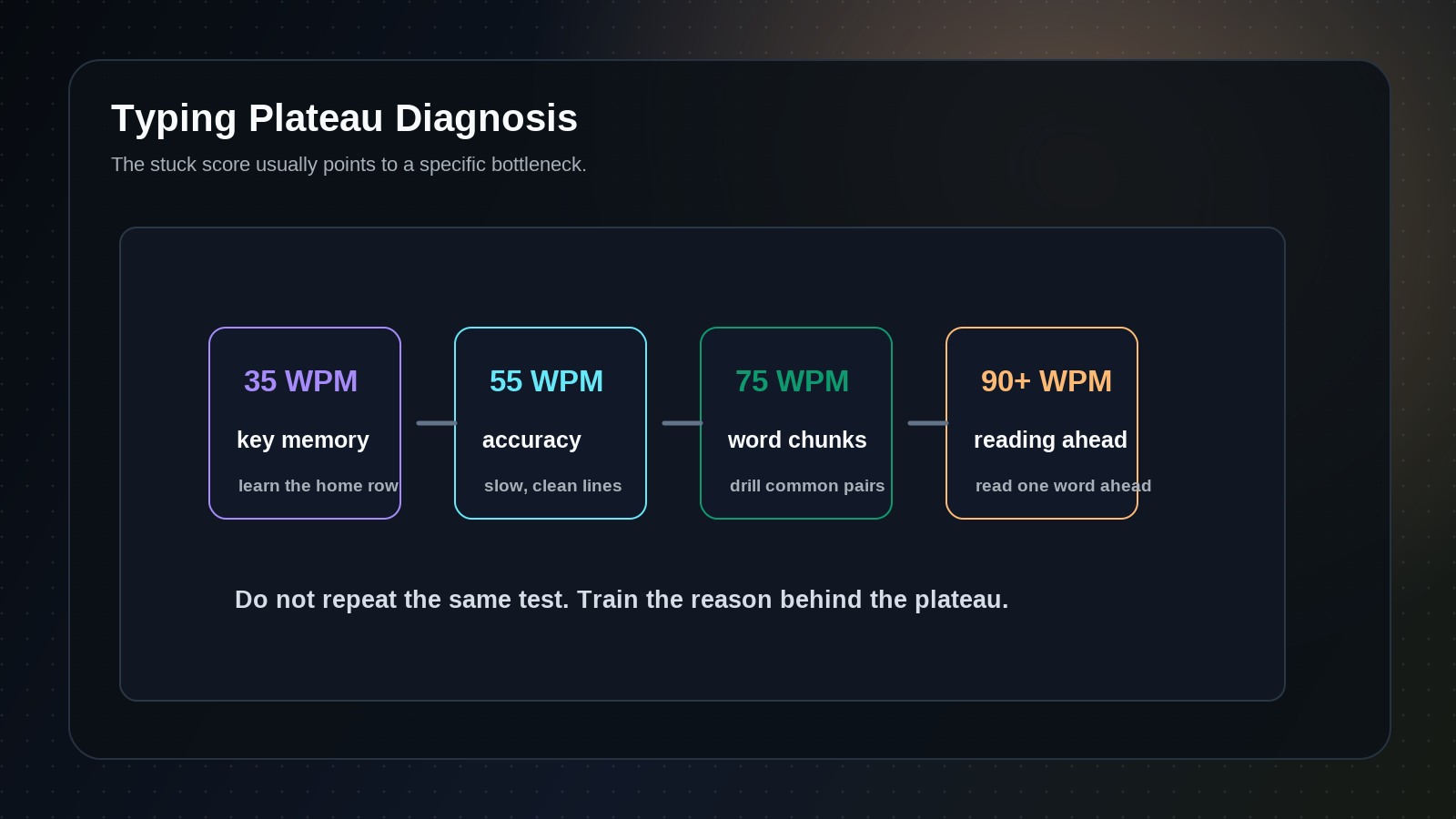
Diagnose the pattern, not the WPM band
A WPM number does not reveal the cause of a plateau.
If you still look down or pause before individual keys, work on key location and a consistent finger map.
If raw pace is much higher than the final result, review errors and correction behaviour.
If short tests are stable but longer tests fade, practise longer text at a controlled pace and watch for fatigue.
If punctuation, capitals, numbers, or unfamiliar words cause the drop, isolate that text type.
If results swing widely under the same settings, work on rhythm and collect several runs before judging progress.
Two people at 60 WPM can need completely different practice. Let the error pattern choose the drill.
Train weak words and letter pairs
If you keep missing the same words, practice those words.
If you keep stumbling on "th," "ion," "ing," commas, or capital letters, drill those patterns.
Fast typing is not one giant skill. It is thousands of small patterns that your hands know well enough to run without drama.
Stop worshipping the one-minute score
One-minute tests are useful, but they can make you practice the wrong thing.
You might get better at one short word list while staying weak at punctuation, names, numbers, paragraphs, and real work text.
If your score is stuck, check other signals:
- Did your accuracy improve?
- Did your worst words get cleaner?
- Did your backspaces drop?
- Can you type longer text without fading?
- Can you keep rhythm when punctuation appears?
If the answer is yes, you are improving even before the headline WPM moves.
Change the test setting
If you always practice short easy word lists, your score may rise there and stay flat everywhere else.
Try longer tests. Add punctuation. Add numbers. Use quotes. Use code if you are a programmer.
This may lower your score at first. That is not bad. It means you finally found practice that shows the weak spots.
What not to do during a plateau
Do not take twenty speed tests in a row and call it practice.
Do not push harder if your hands feel tense.
Do not ignore accuracy because you want one fast screenshot.
Do not change five things at once: keyboard, layout, posture, website, test mode, and practice time.
Pick one bottleneck and work on it for a few days. Plateaus break faster when the practice is boringly specific.
Rest can be part of the fix
Sometimes speed stops improving because you are tired.
If your hands feel heavy, your shoulders are tight, or you keep making mistakes you normally avoid, take a lighter day.
Practice is supposed to teach your hands a cleaner pattern. If fatigue is teaching tension instead, rest is not laziness. It is damage control.
A plateau is usually a signal, not a wall
When speed stops moving, most people assume they need more effort. Sometimes they do. More often, they need a clearer signal.
Look at the shape of the plateau. If every run starts fast and falls apart, you need endurance. If raw speed rises but net WPM stays flat, errors are cancelling the gain. If common words feel easy but punctuation ruins the run, you need targeted drills. If your accuracy is high but rhythm feels stiff, you need short speed exposure.
That is why repeating the same one-minute test can become frustrating. It keeps telling you that you are stuck, but not why.
Use Keytopia's result details as a diagnosis tool. The goal is not to stare at the score harder. The goal is to find the one leak that keeps turning practice into the same result.
Try a seven-day plateau reset
For one week, stop chasing personal records.
Day one: take a normal baseline and write down speed, accuracy, weak keys, and how the run felt.
Day two: practice only accuracy at a slower pace.
Day three: drill the weakest keys or punctuation for ten minutes.
Day four: do short speed bursts, then return to calm typing.
Day five: type a longer passage and watch where form breaks.
Day six: play a typing game or race, but keep accuracy as the main target.
Day seven: retest under the same conditions as day one.
This reset gives each session a job. Compare day seven with day one under the same settings. If nothing changes, use the result to choose a different bottleneck rather than claiming the plan always works.
FAQs
Why am I stuck at 60 WPM?
Sixty WPM is a common plateau because basic keyboard knowledge is no longer enough. You may need better accuracy, faster word chunks, and more practice with punctuation or larger word lists.
Why is my typing speed getting worse?
You may be tired, tense, bored, or practicing harder text than before. Check accuracy and comfort before assuming you lost the skill.
How do I break a typing plateau?
Stop repeating the same easy test. Drill weak words, practice longer text, slow down for accuracy, and add short speed bursts only after the pattern feels clean.
How long does a typing plateau last?
There is no standard duration. First confirm that you are comparing the same test settings. Then track several results after changing one part of practice.
Should I switch typing websites if I am stuck?
Switching can help if the new site changes your practice. But the site alone is not the fix. You need a better routine: weak patterns, accuracy, longer text, and fewer random tests.
Should I practice every day during a plateau?
Practise on a schedule you can repeat without pain or frustration. Session length is less important than matching the drill to the weakness and comparing the same test settings.
Sources
Independent research, official documentation, and source pages behind the claims above.
- Aalto University, analysis of 136 million keystrokeshttps://www.aalto.fi/en/news/the-traits-of-fast-typists-discovered-by-analysing-136-million-keystrokes
- Dhakal et al., observations from 136 million keystrokes (CHI 2018 PDF)https://acris.aalto.fi/ws/portalfiles/portal/21495207/ELEC_Dhakal_et_al_Observations_CHI2018.pdf
Key takeaway
Treat a plateau as a diagnosis problem. Keep test conditions stable, identify one repeated weakness, and choose a drill that matches it.
Free Keytopia typing test
Take a typing test and find the errors costing you speed
Get accuracy, error count, correction detail, weak keys, per-key speed, and slow letter pairs in one result.
No account needed. Save your history after sign-in.
- PaceAverage, raw, peak and low WPM
- ControlAccuracy, errors, consistency and CPM
- TimingReaction, overlap, hold, rhythm and recovery
- PatternsTimeline, heatmap, word, key and bigram speed